

Table of Contents
- What a Mental Block Is and How It Shows Up in Performance
- Common Causes: Fear of Injury, Failure, and Disappointing the Team
- How to Overcome Mental Blocks in Sports: A Step-by-Step Plan
- Mental Blocks in Gymnastics and Other Sports: Adapting the Plan
- Sports Performance Anxiety: When Fear Needs More Than Coaching
- Building a Pre-Performance Routine for Athletes and Tracking Progress
- Frequently Asked Questions
Last Updated: October 14, 2026
What a Mental Block Is and How It Shows Up in Performance
A mental block is a sudden loss of a mastered skill, driven by fear or pressure rather than a physical cause. At Penny For Your Thoughts Counseling Florida, LLC, we work with athletes and coaches who see this in real time, and it rarely looks like a lack of talent. (Source: American Psychological Association’s overview of sport psychology)
Mental blocks are learned fear responses, not character flaws. The brain links a skill to danger, and the body protects itself by bailing out. American Psychological Association overview of sport psychology describes this as a stress response that hijacks movement patterns.
Common signs include:
- Pausing before a skill they have done hundreds of times
- Bailing mid-movement or “forgetting” the next step
- Slow, hesitant practice reps that were once automatic
Signs a Coach Can Spot Before the Athlete Says a Word
Coaches often see the block before the athlete can name it. Watch for changes in body language and practice habits.
Look for these early signals:
- Extra chalk, tape, or equipment checks before a turn
- Standing at the back of the line
- Asking to work on something else
Catch these early, before the fear hardens into a fixed pattern.
Common Causes: Fear of Injury, Failure, and Disappointing the Team
Most mental blocks trace back to three fears: injury or reinjury, failure, or letting others down. Each needs a different response, and first, rule out a physical cause.
Screen First: Is This a Block, or Is Something Else Going On?
A block is a sudden loss of a mastered skill with no physical cause. If any of these are true, treat it as a health concern and refer to a physician, athletic trainer, or licensed clinician before any exposure plan:
- The athlete reports pain, numbness, tingling, or a joint that “gives way”
- The loss came on gradually over weeks, not suddenly
- The athlete is sleeping poorly, eating less, or has lost weight
Reinjury fear and a lingering physical issue can look identical from the sideline. When in doubt, get physical clearance in writing before resuming the skill.
Fear of Injury or Reinjury
This shows up after a fall, a close call, or watching a teammate get hurt. Even after the injury heals, the nervous system stays on guard, the brain tags the skill as “dangerous” and bails out before conscious thought can override it.
What helps: a graded return to the skill with a documented pain and confidence check at each step. What does not help: telling the athlete the injury is “fine now” or that the fear is irrational.
Fear of Failure
This sounds like “I can’t do this” or “everyone is watching.” One mistake becomes proof something is wrong with the athlete, not just the rep. The shift from process focus (“hips square, eyes up”) to outcome focus (“don’t fall, don’t miss”) slows reaction time and disrupts automatic movement.
What helps: redirecting attention to one process cue per attempt. What does not help: “Just relax” or “You’ve done this a thousand times”, both increase outcome focus.
Fear of Disappointing a Coach or the Team
This is the quiet one. Athletes who tie their identity to performance fear losing their spot, their coach’s trust, or their sense of self.
What helps: separating the athlete’s worth from the result out loud, in front of the team. What does not help: singling the athlete out for extra reps in front of peers.
When Pressure and Team Dynamics Make It Worse
A block that starts small can grow fast in the wrong environment. Team culture plays a bigger role than most coaches admit.
These patterns make blocks worse:
- Public criticism after a mistake
- Comparing athletes out loud
- Punishing hesitation with extra reps
When the team treats mistakes as threats, the brain doubles down on protection. The block gets stronger.
Age Changes the Response
How you coach the fear depends on age and developmental stage. One script does not fit a 9-year-old and a 17-year-old.
- Ages 6-10: Fear is often concrete and short-lived. Use simple language (“your body forgot for a minute”), keep sessions short, and loop a parent in early. Do not ask a young child to self-report complex emotions they cannot yet name.
- Ages 11-14: Peer comparison peaks. Reduce public correction, protect the athlete from lineup pressure, and get parent buy-in before any graded exposure plan. Watch for signs the fear is spreading to other skills.
- Ages 15-18: Identity and college recruiting pressure dominate. Athletes this age can co-design their own plan, but they also need explicit permission to slow down without losing status on the team.
For any athlete under 18, get informed consent from the athlete and a parent or guardian before a graded exposure plan, and document what was agreed. If the athlete does not want to proceed, do not push.
How to Overcome Mental Blocks in Sports: A Step-by-Step Plan
Overcoming a mental block takes a plan, not a pep talk.
Total time: 4-8 weeks, depending on how long the block has been in place.
Step 1: Name the fear without judgment.
Ask the athlete what scares them.
Step 3: Add pressure in small doses.
Start with no audience. Add one teammate.
Step 5: Track confidence after every session.
Ask for a 1-10 rating.
Step 6: Return to full skill only when confidence holds.
Move up only when the athlete rates their confidence at 7 or higher for three sessions in a row. (Source: National Institute of Mental Health’s information on anxiety disorders)
What most coaches miss is that rushing back to the full skill too soon resets the block. Slow progress that sticks beats fast progress that collapses under pressure.
Mental Blocks in Gymnastics and Other Sports: Adapting the Plan
The same six steps work across sports, but pressure points and risk profiles differ. Here is a practical adaptation guide for the sports coaches ask about most, plus return-to-skill criteria.
How to Read the Table
Each sport has three variables that change the plan:
- Consequence of failure, what happens if the skill goes wrong
- Controllability, how much of the outcome the athlete controls
- Publicness, how many people see the mistake
High consequence, low control, and high publicness is the worst combination. Adjust exposure speed accordingly.
Gymnastics
Blocks cluster on twisting skills, release moves, and blind landings. Fear of injury here is often rational, not distorted.
- Start on soft surfaces (resipit, pit, tumble track) before the real apparatus
- Rebuild the skill in pieces: shape, then rotation, then full skill
- Do not move to the real apparatus until the athlete rates confidence 7+ on the soft surface for three sessions
Diving and Cheer
Height and inversion drive the fear. Rebuild from lower heights and simpler entries before full height or difficulty.
- Diving: one-meter board, then three-meter, then platform, never skip a level
- Cheer: rebuild stunts on a soft mat with a full spot, then reduce spotters one at a time
- Return-to-skill criteria: three clean reps at each height or spotter level before removing the next layer of support
Baseball and Softball
Blocks show up most on throwing (the “yips”) and hitting after a hit-by-pitch or long slump.
- Throwing: short-toss from 30 feet, then 60, then 90, then long-toss, then mound or position
- Hitting: tee work, then soft toss, then front toss, then live BP, then game-speed pitching
- Return-to-skill criteria: 10 consecutive clean reps at each distance or pitch type before advancing
Basketball
Free throws and close-range finishing are the most common block sites, especially after a missed game-winner.
- Free throws: alone, then with one teammate watching, then with a small group, then in a scrimmage, then in a game
- Finishing: no defender, then a dummy defender, then a live defender at 50%, then 100%
- Return-to-skill criteria: 8 of 10 makes at each level before adding the next layer of pressure
Soccer
Penalty kicks, headers after a collision, and return-to-play after a knee injury are the common sites.
- Penalties: no keeper, then a keeper standing still, then a keeper moving, then a crowd, then a game
- Headers: no contact, then light contact, then full contact, with a documented concussion clearance before any heading
- Return-to-skill criteria: three clean reps at each stage, plus a written medical clearance if the block followed a head or knee injury
Track and Field, Swimming, and Other Individual Sports
Individual sports have less team pressure but more internal pressure. The block often shows up as a false start, hesitation at the blocks, or refusal to dive in.
- Rebuild the start or entry in isolation, then add a single competitor, then a full heat
- Return-to-skill criteria: three clean starts or entries in practice before a meet
What Stays the Same Across Every Sport
- Reduce the threat first, then rebuild the skill, then add pressure slowly
- Never advance a level on a good day alone, require consistency across sessions
- Document each level and the athlete’s confidence rating so the next coach can pick up where you left off
The sport changes the drills, not the sequence. Reduce the threat, rebuild the skill, add pressure in small doses, and only move up when the athlete’s confidence holds across multiple sessions, not just one good day.
Sports Performance Anxiety: When Fear Needs More Than Coaching
Sports performance anxiety is intense fear or worry before or during competition that goes beyond normal nerves. When it affects sleep, appetite, or daily life, coaching alone is not enough.
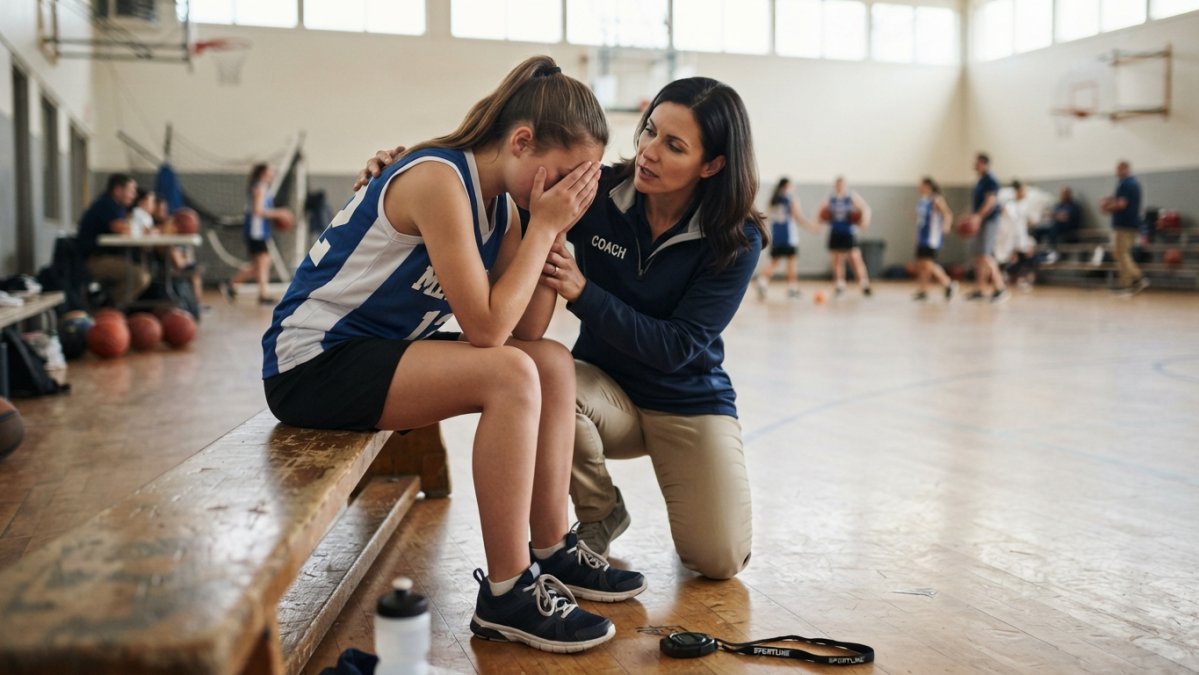
Coaches should watch for these signs that a referral is needed:
- Panic attacks before or during competition
- Avoiding the sport entirely
- Withdrawal from friends and family
If any of these appear, connect the athlete and family with a licensed mental health professional. The National Alliance on Mental Illness resource page offers guidance for families seeking support.
Pushing an athlete through panic symptoms to “toughen them up” can deepen the block and delay recovery. Refer out early when the signs point beyond normal nerves.
Building a Pre-Performance Routine for Athletes and Tracking Progress
A pre-performance routine is a short, repeatable set of actions before every attempt. It gives the brain a familiar script when nerves spike.
A simple routine takes 60-90 seconds:
- Two slow breaths in through the nose, out through the mouth
- One cue word, said silently (“steady,” “smooth,” “go”)
- A quick visualization of the skill done well
- A physical trigger, like clapping chalk or tapping the mat
Track progress with a simple log:
| Week | Confidence Rating (1-10) | Skills Attempted | Notes |
|---|---|---|---|
| 1 | 3 | Basic drills only | Fear high before practice |
| 2 | 5 | One pressure rep per session | Self-talk helped |
| 3 | 7 | Small group pressure | Two clean reps |
| 4 | 8 | Full skill with team watching | Routine steady |
If the rating drops two weeks in a row, slow down. Progress is not linear, a dip signals reduced pressure, not more.
Frequently Asked Questions
What is a mental block in sports called?
It is often described as a performance block or lost move syndrome, especially in gymnastics, where an athlete suddenly cannot execute a skill they have done many times. Sports psychologists treat it as a stress response rather than a physical problem. The athlete’s body knows the movement, but fear, pressure, or a previous fall interrupts the automatic sequence. Naming it accurately helps coaches and parents respond with support instead of frustration.
How can a coach help an athlete overcome a mental block?
Start by reducing pressure and asking open questions about what the athlete feels before the skill. Break the skill into smaller progressions and use gradual exposure, rewarding each step rather than only the final result. Teach self-talk, breathing, and visualization as part of a pre-performance routine. Track confidence ratings and practice consistency so you can see progress. If the block persists for several weeks or comes with intense anxiety, refer to a licensed mental health professional.
When should an athlete seek help from a mental health professional?
Seek professional support when a mental block lasts more than a few weeks, causes distress, or spreads to other areas of the athlete’s life. Warning signs include sleep problems, avoidance of practice, panic symptoms, or comments about quitting. A licensed counselor or sports psychologist can screen for injury-related fear, anxiety, and other health factors. In the Longwood area, a free 20-minute consultation can help families decide whether therapy or performance coaching fits best.
What should a coach avoid saying to an athlete who is struggling?
Avoid phrases like ‘just do it’ or ‘you’re overthinking it,’ which dismiss the fear and increase shame. Do not compare the athlete to teammates or threaten lost playing time. These responses damage the coach-athlete relationship and can deepen the block. Instead, acknowledge the difficulty, ask what feels safest to try next, and keep the athlete involved in decisions. Emotional safety and trust are what allow an athlete to take the small risks that rebuild confidence.
Mental blocks are one of the most frustrating challenges in sport, for athletes and coaches alike. When fear runs deeper than a routine can reach, professional support can make the difference. At Penny For Your Thoughts Counseling Florida, LLC, we offer a free 20-minute consultation, a spa-like environment built for safety, and virtual reality therapy for athletes working through performance anxiety. Contact us today to help your athlete return to the sport they love.
Recent Comments