
Last Updated: October 23, 2026
Quick Summary
Online therapy delivers depression treatment through secure video, phone, or messaging, while in-person counseling happens in a therapist’s office. For many adults with mild to moderate symptoms, teletherapy produces outcomes comparable to in-person care, but severe depression or active suicidal thoughts call for in-person care or a higher level of treatment.
- Most comparative studies measure symptom scores, attendance, dropout, therapeutic alliance, and patient satisfaction.
- Evidence is strongest for live video with a licensed clinician, weaker for text-only and app-based formats.
- Online therapy removes the commute and widens access to any licensed therapist in your state.
- In-person care is the safer default for severe symptoms, trauma work, and people who need structure.
- Hybrid care lets you mix virtual and face-to-face sessions, and switching formats as needs change is common.
Table of Contents
- Online Therapy vs In-Person Counseling: Key Differences
- The Effectiveness of Teletherapy for Depression
- Benefits of In-Person Counseling for Personal Growth
- Convenience, Access, and Privacy Compared
- How to Choose a Therapist for Depression
- Depression Severity, Safety, and Hybrid Care
- Conclusion
- Frequently Asked Questions
Online Therapy vs In-Person Counseling: Key Differences
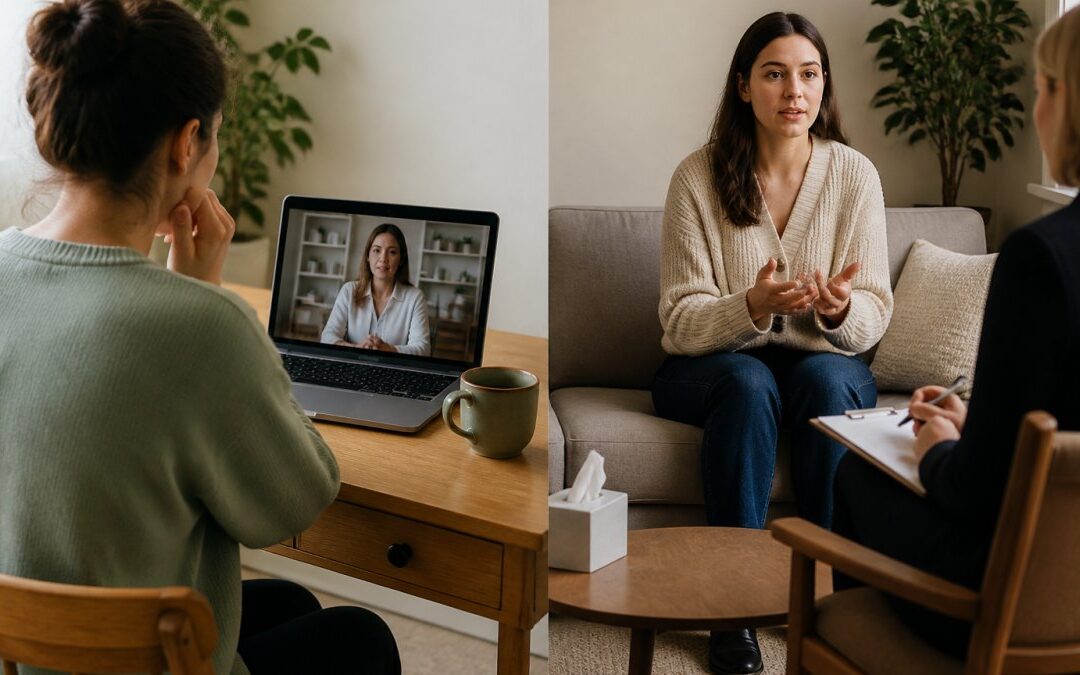
Online therapy is mental health treatment delivered through secure video, phone, or messaging, while in-person counseling happens in a therapist’s office. The core difference is not the quality of care.
How Virtual Sessions Work
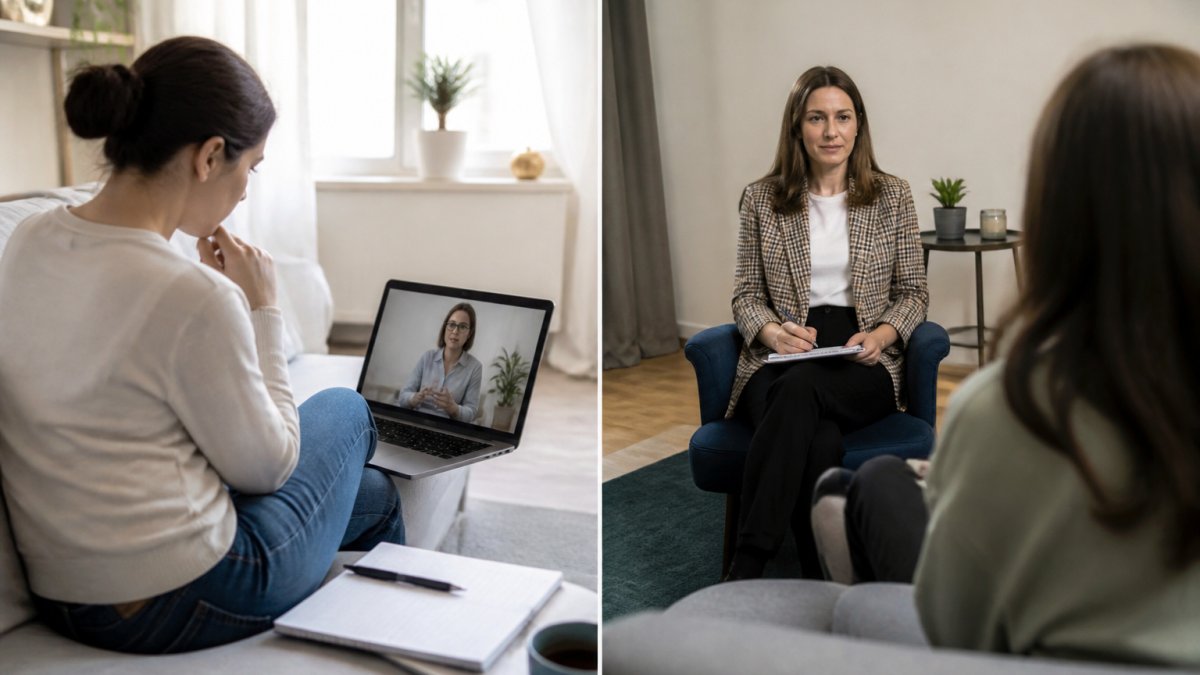
Virtual sessions connect you to a licensed therapist through a secure video platform. You log on from home, a private office, or anywhere with a reliable internet connection. Teletherapy removes the commute and opens access to therapists outside your immediate area. Many people find it easier to fit a session into a busy week this way. The tradeoff: you need a quiet, private space and a connection that holds up.
What Face-to-Face Counseling Offers
Face-to-face counseling puts you and your therapist in the same room. That structured setting offers fewer distractions and a clear boundary between therapy and daily life. Body language and nonverbal communication come through fully, which can deepen the therapeutic connection. For some people, leaving the house and sitting in a dedicated space signals that this hour is different. It can also help when home feels chaotic or when privacy at home is hard to find.
The Effectiveness of Teletherapy for Depression
Teletherapy for depression is widely used, and for many adults with mild to moderate symptoms it produces treatment outcomes comparable to in-person care. The American Psychological Association’s guidance on telepsychology supports telehealth as a valid way to deliver psychotherapy, and the National Institute of Mental Health’s overview of depression treatments describes psychotherapy as a core treatment for depression regardless of delivery format.
What Comparative Studies Actually Measure
Most head-to-head research on online versus in-person depression care measures a handful of things: symptom scores on standardized scales such as the PHQ-9, treatment attendance and dropout, therapeutic alliance ratings, and patient satisfaction. A typical design randomizes adults with mild to moderate depressive symptoms to video-based cognitive behavioral therapy or office-based CBT for 8 to 16 weeks, then compares score changes between groups.
What they measure less often matters just as much:
- Long-term durability. Fewer trials follow participants past the end of active treatment, so we know less about relapse rates a year or more out.
- Severity range. Many studies exclude people with severe depression, active suicidal ideation, psychosis, or recent psychiatric hospitalization, precisely the groups where format choice matters most.
- Therapist and platform quality. Trials usually deliver care through research-grade platforms with trained clinicians, which may not reflect every direct-to-consumer app or messaging service.
Where the Findings May Not Generalize
A few boundaries are worth naming plainly. First, most comparative evidence involves adults; adolescents, older adults with cognitive or hearing challenges, and people with serious comorbid conditions are less well represented. Second, many trials predate the current generation of video platforms, so the technology studied is not always the technology you would use. Third, “online therapy” is an umbrella that covers live video, phone, asynchronous messaging, and self-guided modules, and the evidence is strongest for live video with a licensed clinician, weaker for text-only and app-based formats. Fourth, studies rarely capture the messy realities that shape real attendance: a shared apartment, a spotty connection, a job with unpredictable hours.
What This Means for Your Decision
The honest summary is that virtual care works well for many people with depression, but it is not a universal swap. If your symptoms are mild to moderate and you can arrange a private, reliable space, the evidence supports either format. If your depression is severe, if you have active suicidal thoughts, or if you have tried virtual care and found it hard to stay engaged, in-person care or a higher level of treatment is the safer default.
Benefits of In-Person Counseling for Personal Growth
In-person counseling gives personal growth a physical anchor. The office becomes a place you associate with honesty and change. That consistency can strengthen the therapeutic alliance, the working bond between you and your counselor. When that bond is strong, people tend to engage more and stick with treatment. The benefits of depression counseling for personal growth are real, and for many people the in-person setting makes them easier to reach.
Convenience, Access, and Privacy Compared
Convenience and access often decide which format people actually keep. Online therapy wins on scheduling flexibility and geographic reach. In-person care wins on privacy control and separation from home life. Neither is better in every case. Here is how the two stack up on the factors that shape attendance and engagement.
| Factor | Online Therapy | In-Person Counseling |
|---|---|---|
| Scheduling flexibility | High; no commute | Limited to office hours |
| Geographic access | Broad; any licensed therapist in your state | Local only |
| Privacy control | Depends on your home setup | Guaranteed private room |
| Technology needs | Device plus stable internet | None |
| Nonverbal cues | Good but compressed | Full and immediate |
| Best for | Mild to moderate symptoms, busy schedules | Severe symptoms, trauma work, structure seekers |
Scheduling Flexibility and Geographic Reach
Online therapy removes the commute, and that saved time and effort is often what keeps people in treatment. You can book around work, childcare, or odd hours. Geographic access widens too: you are not limited to counselors within driving distance. If you prefer local, in-person care, see our individual therapy in Winter Park, FL.
Confidentiality and the Home Environment
Confidentiality works differently in each format. In an office, the setting protects your privacy for you. At home, you have to build that privacy yourself: a closed door, headphones, and a time when no one will interrupt. The home environment can also blur the line between therapy and daily stress. A structured office keeps those worlds apart. If your home is loud or crowded, in-person care may protect your sessions better.
How to Choose a Therapist for Depression
Choosing a therapist for depression starts with verifying credentials and fit, not with picking a format first. Look for a licensed mental health professional, confirm their license is active, and ask whether they treat depression specifically. Then check the practical pieces: format, availability, and how you feel in the first conversation. If you are ready to act, our step-by-step guide on how to find a depression therapist near me walks you through the search.
Use this checklist before you book:
- Confirm the therapist’s license is active in your state
- Ask whether they specialize in depression and trauma
- Decide if you want virtual or face-to-face sessions
Ask any therapist directly how they handle a crisis between sessions. The answer tells you more about fit than a list of credentials ever will.
Depression Severity, Safety, and Hybrid Care
Depression severity should drive your format choice, and safety comes first. Most comparisons treat online and in-person care as a binary, but the more useful question is: what level of structure and human presence does your current symptom picture require? Use the tiers below as a starting framework, not a diagnosis.
Matching Format to Symptom Severity
Mild symptoms, low mood, reduced motivation, sleep or appetite changes, but you are still functioning at work and at home.
Moderate symptoms, persistent low mood, noticeable impairment in daily responsibilities, withdrawal from people, or a PHQ-9 score in the moderate range. Both formats can work, but the deciding factor is engagement: which one will you actually attend consistently? A common pattern is that people with chaotic schedules do better virtually, while people who need separation from a stressful home do better in person.
Severe symptoms, major functional impairment, inability to work or care for yourself, or symptoms that have not responded to prior treatment.
Active suicidal thoughts, intent, or plan, or psychosis, this is not a format question. It is a safety question.
Functional Impairment as a Practical Signal
Severity is not only a feeling; it shows up in function. Ask yourself concrete questions: Have you missed work or school because of depression? Are bills, hygiene, or meals slipping? Have you stopped seeing people you used to see? The more areas of daily life that are affected, the more structure and immediacy you likely need, and in-person care tends to provide more of both.
Hybrid Care and Switching Formats
Hybrid care, mixing virtual and face-to-face sessions, is a practical middle path that most comparisons ignore. You might meet in person for deeper trauma work or when symptoms flare, and check in virtually on busy weeks to protect continuity. Switching formats is allowed, common, and often smart as your needs change. A few practical notes:
- Continuity matters more than purity. Staying with the same therapist across formats usually preserves the therapeutic alliance better than switching clinicians to switch formats.
- Ask about cross-format policies up front. Confirm that your therapist offers both, how scheduling works, and whether fees differ.
- Reassess at natural checkpoints. A new season, a job change, a symptom flare, or the end of a treatment phase are good moments to ask whether your current format still fits.
If you have questions about logistics or care options, our frequently asked questions cover the practical side before you commit.
If you or someone you know is in immediate danger, do not wait for a therapy appointment. Call or text 988 to reach the Suicide and Crisis Lifeline, or call 911.
Conclusion
Deciding between online therapy and in-person counseling for depression is really a question of fit, not winners and losers. The format that keeps you engaged and honest is the one that works. If you are in Central Florida and want a safe, spa-like space to do that work, Penny For Your Thoughts Counseling Florida, LLC offers a free 20-minute consultation.
Frequently Asked Questions
Is online therapy as effective as in-person counseling for depression?
Research generally shows that online therapy can be as effective as in-person counseling for mild to moderate depression. Virtual sessions deliver the same evidence-based treatments, such as cognitive behavioral therapy, and many people build a strong therapeutic alliance through video. However, severe depression, active suicidal thoughts, or complex trauma may need the structured setting and immediate safety planning of in-person care. The best format depends on your symptoms, support system, and comfort with technology, so discuss severity and risk with a licensed professional before deciding.
Does insurance cover online therapy the same way as in-person sessions?
Many insurance plans now cover teletherapy similarly to in-person sessions, but coverage varies by plan and state. Before starting, call the number on your insurance card and ask whether virtual mental health visits are covered, what your copay is, and whether the therapist is in-network. Some plans require a specific platform or licensure in your state. If you pay out of pocket, ask the practice directly about session fees and any sliding-scale options, since pricing depends on the provider and services.
What should I look for in a licensed therapist for depression?
Look for a licensed mental health professional, such as a licensed mental health counselor, psychologist, or clinical social worker, with training in evidence-based depression treatments like cognitive behavioral therapy. Verify their license through your state’s licensing board, ask about their experience treating depression, and confirm they are licensed in your state for virtual sessions. A free consultation helps you assess rapport and communication style. Trust your comfort level, and ask how they handle safety concerns and treatment planning.
How do I know if online therapy is a good fit for my mental health needs?
Online therapy may suit you if you have mild to moderate depression, a stable home environment, reliable internet, and a private space for sessions. It helps if commute time, scheduling, or limited local providers have kept you from getting care. In-person counseling may be better if you feel isolated, need stronger emotional connection through body language, or have severe symptoms requiring close monitoring. Many people start with one format and switch or combine both, so ask a licensed therapist which option fits your situation.

Recent Comments